

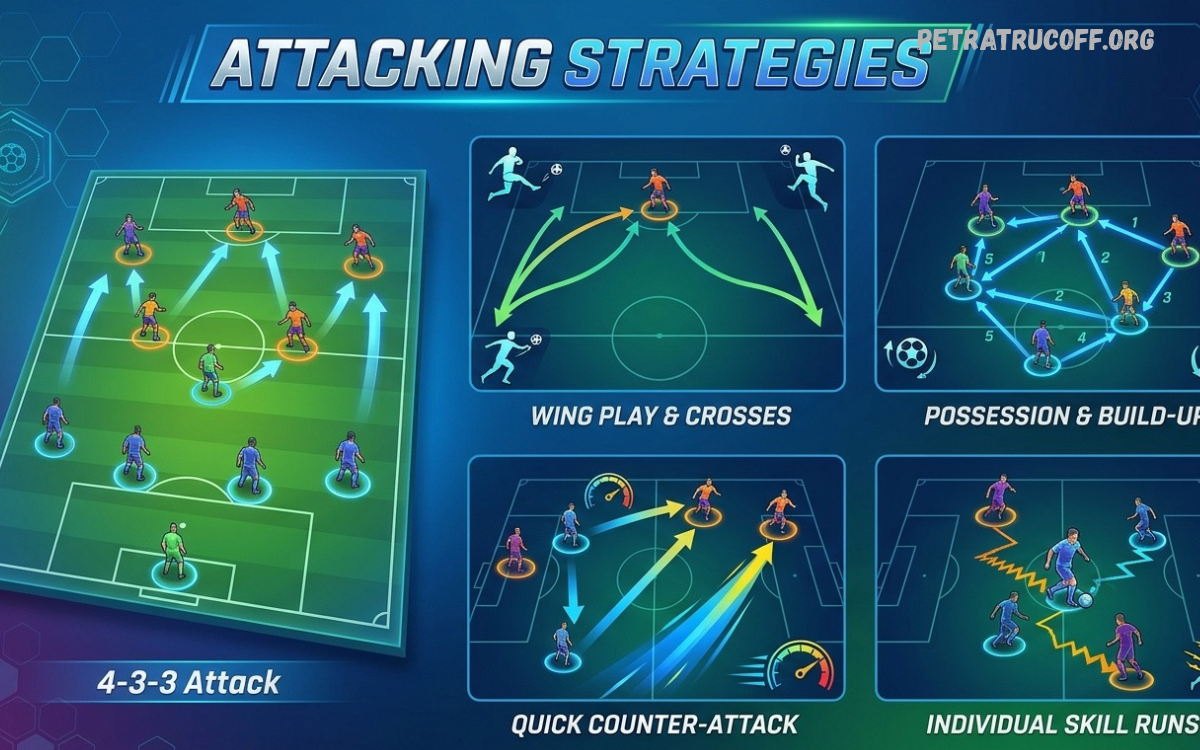
FC Mobile rewards players who combine smart positioning, accurate passing, creative dribbling, and precise finishing. Strong attacking strategies help create scoring opportunities, break defensive lines, and control match tempo.
Mastering FC Mobile attacking strategies takes more than moving players toward the opponent’s goal. Successful attacks depend on recognizing defensive weaknesses, choosing suitable formations, understanding player attributes, and timing the shot.
Understanding the Fundamentals of Attacking
Effective attacking begins with understanding how players move, receive passes, and create space. Instead of rushing forward immediately after gaining possession, observe the opponent’s defensive shape and identify open passing lanes.
Another important principle involves balancing speed with control. Fast attacks can catch opponents off guard, but careless forward movement often leaves possession vulnerable to interceptions.
Choosing the Best Formation for Attacking
Formation selection directly influences attacking movement, passing options, and player positioning. A formation should match your preferred style, available squad, and the way opponents defend. Some formations provide several central passing options, while others create width through wingers and overlapping fullbacks.
The 4-3-3 Attack formation can support wide attacks, creative midfield combinations, and central opportunities. The 4-2-4 offers aggressive forward positioning, while the 4-2-3-1 provides a balance between attacking creativity and defensive stability. Formation effectiveness depends on player quality, tactical settings, and personal control rather than formation numbers alone.
Using the 4-3-3 Attack Formation Effectively
The 4-3-3 Attack formation suits players who enjoy controlling possession and creating chances through wide attackers. Wingers stretch the opposition defense, the attacking midfielder links midfield with the forward line, and the striker provides a central finishing option. This structure offers several routes toward goal without relying entirely on one player.
For better results, avoid sending every attacker forward simultaneously. Use the attacking midfielder to connect passes, move the ball toward an available winger, and look for opportunities to cut inside. When defenders shift toward the ball, a quick pass into the striker can open a direct route toward goal.
Creating Chances Through Short Passing
Short passing remains one of the most reliable attacking techniques in FC Mobile. Quick, accurate passes help maintain possession, draw defenders away from their positions, and create openings near the penalty area. Instead of attempting difficult through balls repeatedly, build attacks through simple combinations between midfielders, wingers, and forwards.
One effective method involves passing sideways before moving forward. This movement encourages opponents to adjust their defensive positions and can reveal gaps between defenders. When an attacker becomes available in space, deliver a forward pass immediately and prepare for a shot, a return pass, or a dangerous run into the box.
Mastering Through Balls and Forward Passes
Through balls help attackers move behind defensive lines and receive possession closer to goal. Their effectiveness depends on timing, passing accuracy, and the movement of the receiving player. A perfectly timed through ball can turn a midfield possession into a clear scoring opportunity, especially when defenders move toward the ball carrier.
Avoid forcing through balls when defenders already occupy the passing lane. Watch for forwards making diagonal runs or accelerating into open space before releasing the pass. Ground through balls can suit situations requiring controlled delivery, while lofted passes may help bypass certain defensive arrangements when sufficient space exists behind the back line.
Improving Dribbling Skills for Better Attacks
Dribbling allows players to escape pressure, beat defenders, and create shooting opportunities. However, effective dribbling depends on direction changes, timing, and space awareness rather than continuous skill moves. A simple change of direction can force a defender to commit and create enough room for a forward pass or shot.
Use skill moves selectively when approaching isolated defenders or entering dangerous attacking areas. Avoid unnecessary tricks in crowded midfield zones because losing possession there can trigger a dangerous counterattack. Players with strong dribbling, agility, balance, and ball control can make these situations easier to manage.
Using Skill Moves to Beat Defenders
Skill moves can provide an advantage when an opponent blocks the direct route toward goal. Moves such as the lane change, roulette, and other available dribbling techniques can help attackers shift direction or create separation. The best choice depends on the player’s skill-move rating, available controls, and the defender’s position.
Practice each move in a low-pressure environment before using it in competitive matches. Learn the correct input, movement direction, and distance needed to create space. Once comfortable, combine a skill move with acceleration or a quick pass to exploit the opening before the opponent recovers.
Attacking Through the Wings
Wing attacks are especially useful against opponents who defend centrally. Wingers can stretch the back line, create one-on-one situations, and deliver crosses into the penalty area. Moving the ball between the fullback, midfielder, and winger can also pull defenders out of position and create space for overlapping runs.
Avoid crossing automatically whenever a winger reaches the edge of the box. First examine the striker’s position, the movement of other attackers, and the number of defenders covering the area. Sometimes cutting inside for a shot or passing backward to an arriving midfielder produces a better chance than sending the ball into a crowded penalty area.
Perfecting Crossing and Heading Techniques
Crossing can become a powerful attacking option when the receiving player has suitable positioning, jumping, heading, and physical attributes. Accurate delivery toward an unmarked forward increases the chance of creating a dangerous aerial opportunity. Crosses work best when attackers occupy useful positions and defenders struggle to track their movement.
Timing is essential when using aerial attacks. Deliver the ball when the striker begins moving into space rather than crossing too early without a clear target. Consider low crosses when attackers are positioned near the goal and aerial deliveries when a suitable forward has room to challenge defenders.
Mastering Cutbacks Inside the Penalty Area
Cutbacks are useful when a winger reaches the byline or enters a dangerous wide position near the goal. Instead of crossing toward the far post, pass the ball backward into the penalty area where a midfielder or striker can receive it facing goal. This approach can create cleaner shooting angles and reduce reliance on difficult headers.
To execute a cutback successfully, check the movement of nearby teammates before releasing the pass. A quick pass toward the penalty spot or an open central area can catch defenders moving toward the goal line. Avoid passing blindly because opponents may anticipate the movement and intercept the ball.
Improving Shooting Accuracy and Finishing
Shooting accuracy depends on positioning, player attributes, goalkeeper placement, and the pressure applied by defenders. Taking a shot from a balanced position often produces a better result than attempting a difficult finish while moving at an awkward angle. Whenever possible, create enough space to shoot before defenders close the distance.
Choose the shot type according to the situation. Standard shots can work well from favorable angles, finesse shots may help when bending the ball around a goalkeeper, and power shots can suit situations with enough preparation time. Available mechanics and effectiveness may vary with game updates, so practice different options using your current controls.
Knowing When to Use Finesse Shots
Finesse shots are useful when an attacker has a favorable angle and enough space to attempt a controlled, curved finish. Players with strong finishing, curve, and shooting attributes may perform particularly well in suitable situations. The objective is to place the ball away from the goalkeeper rather than simply applying maximum power.
Before attempting a finesse shot, consider the distance to goal and the goalkeeper’s position. Shooting from a wide angle under heavy pressure may produce an unreliable attempt. Move into a better position, create separation from the defender, and select the shot when the available angle supports a controlled finish.
Using Power Shots at the Right Moment
Power shots can be effective when attackers have time and space to prepare a strong attempt. They may work well from suitable positions outside or near the penalty area, particularly when defenders cannot close down the shooter quickly. However, preparation and accuracy matter because a heavily contested shot can be blocked before reaching the goalkeeper.
Use power shots selectively rather than treating them as the default finishing method. Check the defender’s distance, the goalkeeper’s positioning, and the shooting angle before committing. If an opponent is approaching rapidly, a quick standard shot or pass toward a better-positioned teammate may provide a more practical attacking solution.
Building Effective Counterattacks
Counterattacks exploit opponents who move too many players forward. After winning possession, identify open space and move the ball toward an available winger or striker. A fast, accurate forward pass can bypass several opposing players and create a numerical advantage before the defense reorganizes.
Successful counterattacks require quick decisions without sacrificing accuracy. Avoid carrying the ball unnecessarily when a teammate has already made a useful run. If the direct route is blocked, switch the ball to the opposite side or use a short supporting pass to keep the attack going.
Read Also: EA FC Beginner Tips: Essential Tricks to Improve Your Gameplay
Recognizing Defensive Weaknesses
Reading the opponent’s defensive behavior helps you choose the right attacking strategy. Some opponents defend aggressively and leave space behind their defenders, while others maintain a compact shape near the penalty area. Recognizing these patterns lets you choose the right passing combinations, dribbling moves, and shooting positions.
Against aggressive defenders, use quick passes and well-timed runs behind the defensive line. Against compact defenses, circulate possession, switch the play, and use patient combinations to create openings. Repeating the same attack makes your approach predictable, so changing direction and tempo can help keep opponents uncertain.
Using Player Positioning to Create Space
Player positioning determines whether passing options remain available during an attack. A forward who stays close to defenders may struggle to receive the ball, while a player moving into open space can create a valuable passing lane. Recognizing these movements helps you progress toward goal without depending on risky individual dribbling.
Use diagonal runs to separate attackers from defenders and create better angles for forward passes. Wingers can move inside to open space for overlapping fullbacks, while central midfielders can support attacks from behind. Maintaining suitable distances between players gives the ball carrier more options and makes attacking combinations harder to predict.
Selecting the Right Striker for Your Playstyle
The striker plays a central role in converting attacking opportunities into goals. Different forwards offer different advantages, including pace, finishing, strength, positioning, agility, and aerial ability. Selecting a striker whose attributes match your preferred approach can make your overall attacking system more effective.
A quick striker may suit counterattacks and through balls, while a physically strong forward may help with holding up possession and challenging defenders. Players with reliable finishing can benefit teams that create frequent chances inside the box. Consider weak-foot ability and skill-move ratings as well when comparing available players.
Choosing Wingers for Maximum Attacking Impact
Wingers provide width, speed, and creativity in the final third. Their pace helps exploit space on the flanks, while dribbling and crossing attributes influence their ability to beat defenders and deliver dangerous passes. A winger who can also finish effectively gives your team an additional goal-scoring threat when cutting inside.
Consider your preferred attacking pattern before choosing wide players. If you frequently cross, prioritize suitable crossing and passing attributes alongside movement. If you prefer cutting inside, focus on dribbling, acceleration, finishing, and a useful shooting profile. Strong weak-foot ability can also make a winger less predictable when attacking from either side.
Improving Attacks Through Midfield Control
Midfielders connect defensive possession with forward movement and help maintain attacking rhythm. Creative midfielders can provide accurate through balls, while technically skilled players help retain possession under pressure. A balanced midfield gives attackers regular support and reduces the risk of isolated forward play.
Avoid sending every midfielder forward without considering defensive coverage. Keep at least one suitable player available to recycle possession or help protect against counterattacks. When the opponent blocks central passing lanes, move the ball toward the wings and look for a better route back into the attacking area.
Using One-Touch Passing Combinations
One-touch passing can accelerate attacks by reducing the time defenders have to react. Short combinations between midfielders and forwards allow the ball to move through crowded spaces quickly. This method works particularly well when teammates are positioned close enough to receive accurate passes and continue the attack immediately.
Start with simple two-player combinations before attempting more complex passing sequences. Pass to a teammate, move into a useful position, and look for a return pass or a forward run. Avoid using one-touch passing when the receiving player faces heavy pressure or has no clear passing option.
Managing Attacking Pressure in Head-to-Head
Head-to-Head requires a balance between creating opportunities and protecting possession. Since opponents can actively respond to your movements, predictable attacks are easier to defend. Mixing short passing, wing play, through balls, and controlled dribbling helps maintain variety throughout the match.
Do not allow the desire to score quickly to undermine your overall strategy. If the opponent defends aggressively, use that pressure to find space behind the defensive line. If the opponent remains compact, slow the tempo and move the ball until a suitable opening develops.
Attacking Strategies for Division Rivals
Division Rivals rewards consistent performance, making reliable attacking decisions particularly important. Focus on creating clear chances instead of attempting low-probability shots from every position. Accurate passing, careful player selection, and disciplined finishing can improve results over time.
Review your matches to identify recurring mistakes, such as losing possession near the penalty area or forcing passes through crowded spaces. Adjust your formation or attacking approach when a particular strategy repeatedly fails. Developing a flexible style helps you respond to opponents with different defensive habits.
Customizing Controls for Better Attacking
Comfortable controls can improve the accuracy of passes, shots, skill moves, and player movement. Spend time learning the available button layouts, gesture controls, and settings supported by your version of FC Mobile. Choose an arrangement that allows you to perform important actions without unnecessary delays.
Practice shooting, passing, sprinting, and skill moves until the inputs feel consistent. Avoid changing several control settings immediately before competitive matches because unfamiliar layouts can disrupt your timing. A familiar setup helps you focus on reading the game rather than remembering which action to perform.
Avoiding Common Attacking Mistakes
One common mistake is sprinting continuously while carrying the ball. Excessive sprinting can make controlled movement and precise decisions more difficult, especially in crowded areas. Release sprint when necessary, assess available passing options, and accelerate again when open space appears.
Another mistake involves forcing shots and passes under pressure. Shooting from poor angles or attempting predictable through balls gives defenders opportunities to regain possession. Improve your decision-making by checking teammate positions, creating space before shooting, and choosing the safest useful passing lane.
Practicing Attacking Skills Efficiently
Regular practice helps develop reliable timing and better decision-making. Focus on one skill at a time, such as through balls, finesse shots, wing attacks, or close-control dribbling. Repeating a specific technique helps you understand when it works and which situations make it less effective.
After practicing individual skills, combine them into complete attacking sequences. Build possession through midfield, move the ball toward a winger, create a central opening, and finish when a suitable opportunity appears. This approach helps turn isolated techniques into a more organized attacking system.
Adapting Attacking Strategies to Game Updates
FC Mobile may change gameplay mechanics, player attributes, formations, and competitive balance through updates. A technique that performs well in one version may require adjustments in another. Keeping up with official patch notes and testing your tactics helps ensure your strategy remains suitable for the current gameplay environment.
Avoid relying entirely on outdated guides or claims about guaranteed scoring methods. Test different formations, players, and finishing options after significant updates. Observe how defenders react, how passes travel, and which opportunities consistently produce good chances in your matches.
Developing a Complete Attacking Game Plan
A complete attacking game plan combines formation selection, passing, dribbling, movement, and finishing. Start by identifying your preferred style, whether possession-based, quick counterattacks, wing play, or central combinations. Build your squad and tactics around that approach while keeping alternative options available for difficult opponents.
During matches, assess the opponent’s defensive structure and adjust your decisions accordingly. Use patience when space is limited, accelerate when a clear opening appears, and prioritize accurate finishing over unnecessary attempts.
Frequently Asked Questions
What Are the Best FC Mobile Attacking Strategies?
The most effective strategies combine accurate passing, intelligent movement, controlled dribbling, and suitable finishing. Choose a formation that fits your squad and adapt your attacks to the opponent’s defensive structure.
Which Formation Is Best for Attacking in FC Mobile?
The 4-3-3 Attack, 4-2-4, and 4-2-3-1 can all support effective attacking play. The best option depends on your players, preferred tactics, and ability to maintain defensive balance.
How Can I Score More Goals in FC Mobile?
Create space before shooting, use through balls when forwards make suitable runs, and choose shot types according to the angle and pressure. Avoid forcing low-quality attempts when a better passing option exists.
How Do I Beat Defenders in FC Mobile?
Use controlled dribbling, timely direction changes, and skill moves when appropriate. Quick passing can also help bypass defenders without relying on individual tricks.
Are Through Balls Effective in FC Mobile?
Through balls can be effective when attackers move into open space behind defenders. Timing and passing accuracy are essential, so avoid forcing them through crowded passing lanes.
How Can I Improve My Attacking Skills?
Practice passing, shooting, dribbling, and movement separately before combining them in complete attacks. Review match mistakes and adjust your tactics based on the situations you face.
What Is the Best Way to Attack Against Defensive Opponents?
Maintain possession, switch play between the wings, and use short passing combinations to draw defenders out of position. Patient buildup can create openings that direct attacks often miss.
How Can I Improve Counterattacks in FC Mobile?
Move the ball forward quickly after winning possession, identify open teammates, and use accurate passes to exploit space. Make quick decisions and avoid unnecessary dribbling or risky passes.
Conclusion
Mastering FC Mobile attacking strategies takes practice, awareness, and smart decision-making. Accurate passing, effective dribbling, well-timed through balls, suitable formations, and controlled finishing can help you create better scoring opportunities across different competitive modes.
Experiment with different attacking approaches and choose the techniques that suit your squad and personal playstyle. By learning from mistakes, adapting to opponents, and practicing essential skills, you can build a more confident attacking system and improve your overall FC Mobile performance.

1 comentario
Pingback: FC Mobile Career Mode Guide: Tips, Strategies, and Winning Tactics - PetraTrucoff