

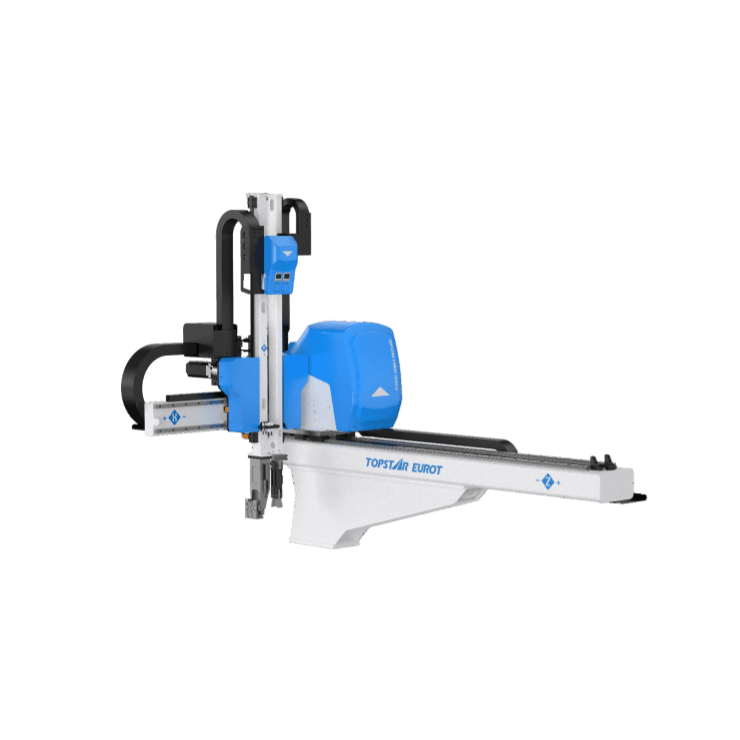
In continuous injection molding production cells, maintenance-related downtime can rapidly erode efficiency and drive up operating costs. As a manager at Topstar responsible for high-end molding equipment and automation products, I have witnessed how self-lubricating linear guide technology has revolutionized the viability of long-cycle automated operations. This design enables a Cartesian Coordinate robot to operate continuously for 65 days without manual lubrication, thereby reducing scheduled downtime, lowering labor requirements, and ensuring predictable performance for high-output production cells.
The Maintenance Burden of Traditional Linear Guides in Cartesian Robots
In high-utilization Cartesian Coordinate robot production cells, the maintenance burden associated with traditional linear guides is evident. Standard ball or roller guides require periodic grease replenishment to prevent wear, corrosion, and increased friction. In dusty environments or during continuous operation, lubrication intervals often need to be shortened, forcing technicians to interrupt production more frequently.
Each lubrication task consumes person-hours, increases the risk of contaminant ingress, and can lead to uneven or incomplete grease distribution. On an annual basis, the resulting cumulative downtime and labor costs are substantial. Topstar’s analysis of customer operations reveals that lubrication-related downtime is one of the most common causes of scheduled interruptions in traditional Cartesian Coordinate robot.
Principles of Self-Lubricating Linear Guide Technology in Cartesian Robots
The core of self-lubricating linear guide technology lies in the presence of a continuous lubrication medium within the guide system. Components made of specialized polymers or composite materials—impregnated with lubricant—release precise amounts of lubricant onto the raceways and rolling elements during motion. Consequently, Cartesian Coordinate robot receive long-term, continuous protection without the need for external grease application.
Topstar integrates these self-lubricating guides into the axis design of its Cartesian robots, ensuring reliable lubrication across the entire range of travel and load conditions. The system is specifically engineered to maintain stable lubricant film strength under the acceleration, speed, and duty cycle conditions typical of injection molding automation. Sealing elements further protect the internal lubricant from external contaminants, thereby facilitating extended maintenance intervals.
Achieving 65-Day Maintenance-Free Operation for Cartesian Robots
Achieving 65 days of maintenance-free operation is a proven result of equipping Cartesian robots with well-designed, self-lubricating guide rails. Topstar conducted accelerated life testing on this design, simulating continuous production conditions, and confirmed that lubrication effectiveness and positioning accuracy remained within specifications throughout the entire cycle. In practical applications, this 65-day cycle offers a pragmatic and predictable maintenance schedule. Factories can synchronize lubrication checks with other planned maintenance activities or, under favorable conditions, extend maintenance intervals even further. The Cartesian Coordinate robot maintains consistent motion performance while eliminating the need for frequent manual intervention.
Impact on Uptime and Overall Equipment Effectiveness (OEE)
Eliminating maintenance-related downtime for lubrication leads to a rapid increase in the Cartesian robot‘s uptime and Overall Equipment Effectiveness (OEE). Every instance of avoided manual intervention translates into saved production time—gains that accumulate significantly across multiple work cells and shifts. Equipment availability improves, allowing work cells to dedicate more time to part production rather than waiting for maintenance.
Topstar customers tracking OEE data typically record marked efficiency improvements after implementing this solution, primarily due to reduced scheduled downtime. The injection molding robot becomes a more predictable component of the production system, simplifying scheduling and reducing the buffer time previously required for maintenance tasks. Higher utilization of existing assets boosts the return on investment without the need for additional equipment purchases.
Reducing Contamination Risks and Ensuring Cleaner Robot Operation
Eliminating routine manual greasing helps reduce contamination risks and ensures cleaner operation for Cartesian robots. Manual lubrication often results in excess grease transferring to parts, molds, or conveyor belts. In applications requiring high cleanliness or sensitive to aesthetic quality, such contamination poses quality risks and increases the workload associated with cleaning.
Self-lubricating guide rails retain lubricant within the rail system, thereby minimizing external contamination. The cleaner operation of the Cartesian robot not only supports higher standards for part handling but also reduces the risk of defects caused by grease. Furthermore, the factory avoids environmental and on-site hygiene issues associated with the frequent application and disposal of grease.
Long-term Reliability and Wear Performance of Self-Lubricating Guide Rails
Long-term reliability and wear performance determine whether a Cartesian robot can maintain a 65-day maintenance interval throughout its service life. The self-lubricating material must continuously release sufficient lubricant and protect the raceways over millions of operating cycles. Topstar has verified wear rates, positioning accuracy, and lubrication effectiveness through extended testing that exceeded standard maintenance intervals. Field data confirms that, when operated
